
Phone Batteries Are Finally Getting Interesting Again
Smartphone upgrades have spent years chasing faster chips, smarter cameras, and AI features. But silicon-carbon batteries may be delivering something users can actually feel every day: longer battery life without turning modern phones into bulky bricks.
 Vortixel
9 minutes read
Vortixel
9 minutes read
For years, the smartphone battery conversation has been painfully predictable.
A new phone arrives. Its processor is faster. Its cameras are smarter. Its display gets brighter. The manufacturer talks about efficiency improvements, machine learning, computational photography, and some new software feature that looked fantastic during the keynote.
Then you look at the battery capacity and see something suspiciously familiar.
Maybe 4,800mAh. Maybe 5,000mAh. Maybe slightly more.
It became normal enough that most of us stopped expecting anything different.
That is starting to change.
One of the more consequential smartphone trends of 2026 isn’t another generative AI trick or a camera capable of zooming far enough to photograph a sign you probably could have walked toward. It is happening inside the least glamorous part of the phone.
The battery.
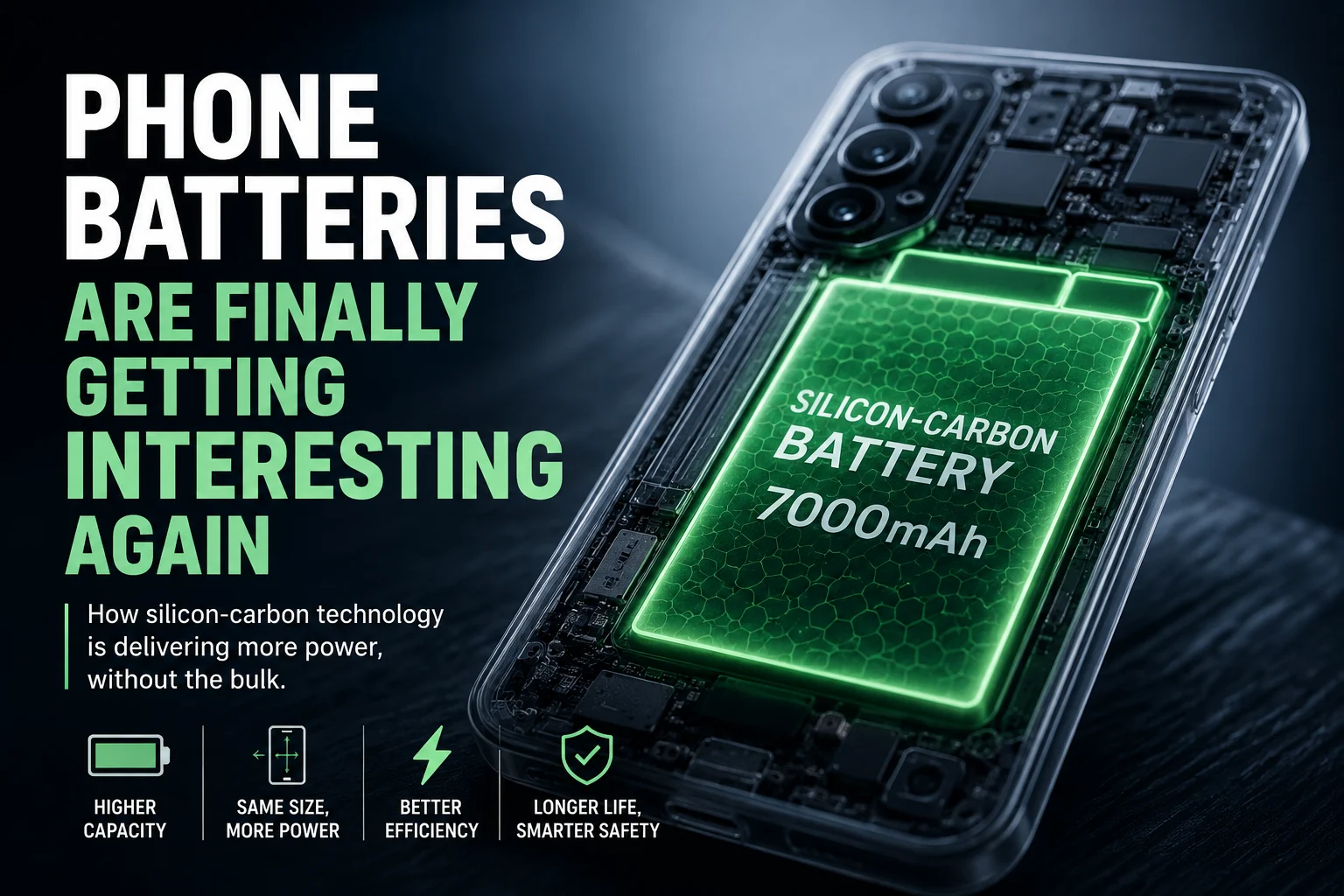
Silicon-carbon battery technology is increasingly allowing manufacturers to fit dramatically larger capacities into devices without requiring the kind of thickness increase that would have made those numbers impractical a few years ago.
The shift is already visible in the market. According to Counterpoint Research, smartphones with batteries of at least 6,000mAh represented 29% of global smartphone sales in January 2026, compared with only 10% in January 2025. Average global smartphone battery capacity also climbed to 5,291mAh during the same period.
Those percentages might sound like another industry statistic.
They are actually telling us something much more interesting.
The 5,000mAh ceiling is beginning to crack.
We Spent Years Optimizing Around the Battery Problem
Modern smartphones have always been built around compromises.
You want a faster processor? It needs power.
You want an extremely bright OLED display? More power.
You want continuous background synchronization, location tracking, high-refresh-rate animations, sophisticated cameras, 5G connectivity, satellite features, and increasingly local AI processing?
All of those things eventually meet the same physical object sitting behind the display.
The battery.
Manufacturers became extremely good at hiding this limitation.
Processors grew more efficient. Displays dynamically adjusted refresh rates. Operating systems became increasingly aggressive about managing background activity. Camera pipelines completed computational workloads faster. Charging speeds increased so that running out of power became slightly less annoying.
These were genuine improvements.
But they were also elegant ways of working around a fairly stubborn constraint: there was only so much energy you could comfortably put inside a thin smartphone.
For years, around 5,000mAh became an unofficial comfort zone across much of the industry.
Not because consumers collectively decided it was the perfect amount of battery.
Because phone design had settled into a complicated equilibrium involving size, weight, chemistry, thermal behavior, charging, internal components, and the aesthetic expectation that premium smartphones should remain relatively thin.
Silicon-carbon chemistry changes that equation.
Not magically.
But enough to matter.
Bigger Batteries Without Bringing Back the Brick
The important thing about silicon-carbon batteries isn’t simply that manufacturers can advertise larger numbers.
It is energy density.
Using silicon-containing anodes can allow more energy to be stored within a similar physical volume than traditional graphite-heavy designs. In practice, smartphone manufacturers have increasingly used this advantage to push battery capacities upward while keeping devices within dimensions consumers would still consider normal.
That is why we’re now seeing phones comfortably crossing 6,000mAh and, in more aggressive designs, moving significantly beyond it.
Counterpoint says adoption of silicon-carbon technology has helped accelerate this transition, with Chinese smartphone manufacturers playing a particularly important role in bringing larger-capacity batteries into mainstream devices.
This is where Gaxel gets interested.
Because smartphones have had plenty of specification races that ultimately mattered less than expected.
Screen resolution went far beyond what many people could meaningfully distinguish.
Processor benchmarks became absurdly fast compared with normal daily workloads.
Camera systems accumulated enormous megapixel counts.
Charging wattage became another number manufacturers could race toward triple digits.
Battery capacity is different.
Most people understand immediately what happens when a phone lasts longer.
You stop thinking about chargers.
The Best Battery Feature Is Forgetting About the Battery
There is a peculiar threshold with battery life where the experience changes.
Moving from six hours of heavy use to seven hours is useful.
Moving from constantly worrying about getting through the evening to reliably reaching the following morning is something else entirely.
The phone becomes less demanding.
You leave home without checking the percentage.
You use navigation without mentally calculating what it will cost.
You record video without wondering whether the camera will destroy the remaining battery.
You travel without immediately hunting for an airport outlet.
You forget your power bank.
That last one might be the most meaningful benchmark of all.
Smartphone reviews usually describe battery life using screen-on time, standardized endurance tests, video loops, or percentages remaining at the end of a day.
Those measurements are necessary.
But the psychological effect of long battery life is harder to quantify.
A device that reliably outlasts your routine creates a different relationship with charging.
Charging stops being part of your schedule.
That is exactly the kind of improvement mature technology products need.
Not necessarily another feature.
Less friction.
Meanwhile, AI Is Asking for More Power
The timing couldn’t be better.
Smartphone manufacturers are simultaneously moving toward increasingly ambitious AI workloads.
Google’s newly announced Pixel 11 lineup, for example, centers heavily on its Tensor G6 platform and deeper Gemini integration, continuing the industry’s push toward devices that perform more intelligent processing directly within the smartphone experience.
On-device AI has obvious advantages.
Lower latency.
Better privacy for certain workloads.
Features that remain useful without constantly reaching a cloud server.
But computational intelligence is not free.
It requires processing.
Processing requires energy.
And suddenly, the old approach of squeezing marginal efficiency improvements out of roughly the same battery capacity begins to look increasingly awkward.
The smartphone industry wants phones doing more things in the background, understanding more context, processing more media, and eventually anticipating what users need before they explicitly ask.
Fine.
Then give them enough battery to do it.
This is why battery chemistry may end up being one of the technologies quietly enabling the AI-phone era while receiving a fraction of the attention.
The AI assistant gets the keynote demo.
The battery makes sure you can still order a ride home afterward.
Chinese Phone Makers Have Been Pushing Hardest
Another interesting part of this story is where the aggressive experimentation has been happening.
Chinese smartphone brands have generally moved faster toward very large battery capacities than some of the biggest Western-market flagship lines.
Counterpoint’s data shows Chinese OEMs dominating the ≥6,000mAh smartphone segment as silicon-carbon adoption expanded.
That creates an increasingly strange comparison.
A consumer might look at a premium phone from one manufacturer and see sophisticated AI, advanced camera processing, premium materials, and excellent ecosystem integration.
Then another phone appears with similar dimensions and hundreds—or potentially thousands—of additional milliamp-hours of battery capacity.
At some point, consumers begin asking why.
That question matters.
Smartphone markets don’t evolve only because a new technology becomes available.
They evolve when buyers discover that one manufacturer’s compromise is not necessarily unavoidable.
We have seen this happen before.
High-refresh-rate displays moved from enthusiast feature to mainstream expectation.
Fast charging spread aggressively.
Periscope telephoto cameras became recognizable flagship differentiators.
Large batteries could follow a similar trajectory.
Once people experience a phone that comfortably survives usage patterns that previously required an afternoon charge, going backward becomes difficult.
There Are Still Trade-Offs
None of this means every silicon-carbon battery phone is automatically better.
Battery technology remains an engineering problem involving far more than capacity.
Longevity matters.
Heat matters.
Charging behavior matters.
Battery management systems matter.
Cycle degradation matters.
Manufacturing quality matters.
A 7,000mAh label cannot tell you whether the battery will age gracefully after several years.
Nor does larger capacity automatically guarantee extraordinary endurance.
Software optimization can destroy impressive hardware.
Poor modem efficiency can destroy it.
An excessively power-hungry display can destroy it.
Background apps can destroy it.
And manufacturers still have incentives to convert improvements in energy density into thinner devices instead of longer-lasting ones.
That may become the next battle.
Engineers discover a way to fit more energy into the same space.
Consumers imagine longer battery life.
Industrial designers imagine removing another millimeter from the chassis.
Please don’t.
There is a point where thinner stops making a phone meaningfully better.
There is no equivalent point where reaching the end of a long travel day with 35% remaining becomes annoying.
Maybe We Have Been Measuring Smartphone Progress Wrong
The smartphone industry has a maturity problem.
New devices are extraordinarily capable, but annual improvements increasingly struggle to change how most people actually use them.
That isn’t necessarily a failure.
It is what happens when a technology becomes good.
The refrigerator industry doesn’t need to reinvent food storage every September.
Smartphones eventually had to reach a similar point.
This makes practical improvements more valuable.
Better durability.
Longer software support.
More repairable construction.
Better connectivity.
Less intrusive software.
And yes, longer battery life.
These changes rarely create spectacular stage demonstrations.
Nobody cheers while a presenter announces that you will think about your charger less frequently.
Yet this might be precisely what mature consumer technology should optimize for.
The goal shouldn’t always be making users notice technology more.
Sometimes good technology disappears into the routine.
A 7,000mAh Phone Changes Different People Differently
There is also no universal definition of good battery life.
A person working mostly from home with chargers everywhere might barely notice the difference.
A traveler will.
A delivery driver will.
A mobile gamer definitely will.
Someone recording hours of video will.
People using their phones as primary computing devices in markets where desktop ownership is lower may care enormously.
That is another reason the expansion of battery capacity matters globally.
Smartphones aren’t accessories for everyone.
For billions of people, they are cameras, navigation systems, entertainment devices, communication tools, banking terminals, work computers, authentication devices, and connections to the internet wrapped into one object.
The more responsibilities we give that object, the stranger it becomes to accept mediocre endurance.
The Next Flagship Battle Could Be Embarrassingly Simple
Flagship phones have spent years competing over increasingly sophisticated technologies.
AI models.
Custom processors.
Computational photography.
Foldable displays.
Satellite connectivity.
Spatial computing.
Some of those innovations will genuinely shape the future.
But there would be something almost funny if one of the most persuasive upgrades of the next few smartphone generations turned out to be:
The battery lasts much longer.
No explanation required.
No tutorial.
No developer ecosystem needed.
No demonstration where a carefully prepared AI prompt produces the perfect answer.
You charge the phone.
You use it.
It keeps working.
That simplicity might actually be its greatest advantage.
Battery Anxiety Should Eventually Feel Old-Fashioned
Technology becomes interesting when it removes behaviors we once considered unavoidable.
We used to manage phone storage constantly.
We used to carry separate cameras.
We used to download maps before traveling.
We used to wait minutes for websites to load.
Maybe checking the battery percentage several times a day will eventually join that list.
Silicon-carbon batteries alone won’t get us there. Better chips, displays, software, cellular radios, charging systems, and power management all contribute to the equation.
But something clearly has shifted.
Large-capacity smartphones are no longer niche endurance monsters shaped like rugged equipment. The market is increasingly demonstrating that substantially more battery can coexist with devices people actually want to carry.
And compared with many of the technologies competing for attention in 2026, that feels unusually tangible.
AI might eventually transform the smartphone.
New form factors might eventually replace parts of it.
Smart glasses might eventually take some tasks away from the screen.
But right now, one of the nicest upgrades happening in consumer technology is much less futuristic.
Phones are finally learning how to stay alive longer.
For once, the bigger number on the specification sheet might actually deserve our attention.