8BitDo FlipPad Makes Phone Gaming Retro Again
 Vortixel
17 minutes read
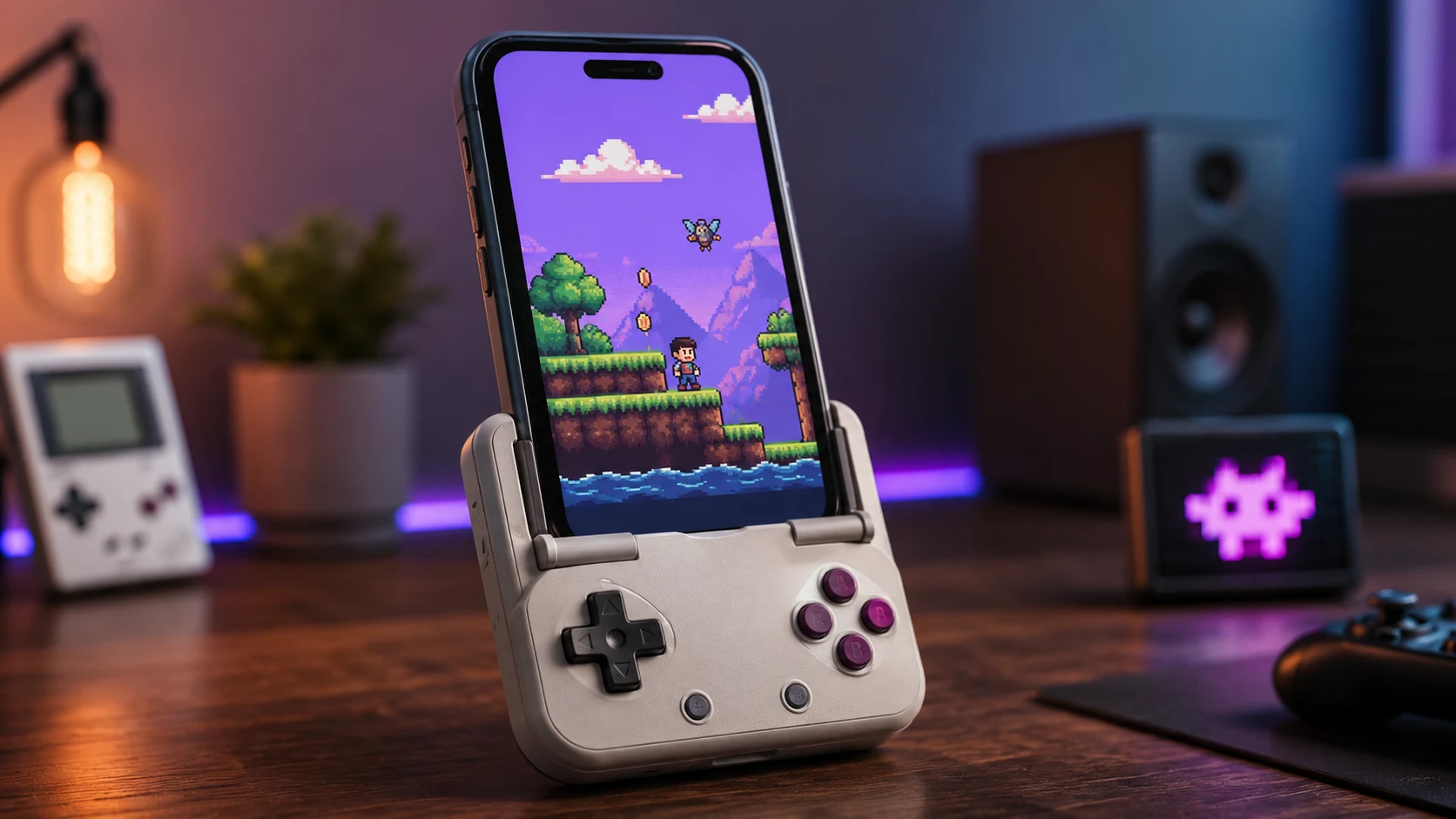
The easiest way to understand the hype around the 8BitDo FlipPad is to picture a modern smartphone suddenly remembering it has a retro soul. For years, mobile gaming has been stuck between two identities: wildly powerful on paper, awkward in the hands. Phones can run beautiful games, stream console titles, and emulate classics with crisp screens, yet too many sessions still end with thumbs sliding across glass like they are trying to win a fight with the interface itself. The 8BitDo FlipPad enters that space with a charmingly simple promise: turn the phone into something that feels closer to a tiny Game Boy-style handheld. It is not trying to be the loudest gaming accessory in the room, and that is exactly why it feels interesting.
Mobile gaming accessories usually arrive with big claims, RGB confidence, and bulky designs that make a phone look like it has been swallowed by a controller shell. The 8BitDo FlipPad takes a different path by leaning into portrait gaming, compact controls, and a fold-style idea that feels nostalgic without being trapped in the past. Instead of asking players to rotate their phone into a landscape console imitation, it embraces the vertical shape most people already use every day. That one design decision changes the whole vibe, especially for retro games, arcade titles, and quick sessions between commutes, classes, breaks, or late-night scrolling. In a gadget market obsessed with going bigger, the FlipPad’s appeal is that it makes the phone feel smaller, cuter, and more intentional.
Why the 8BitDo FlipPad Feels Different
The core idea behind the 8BitDo FlipPad is not complicated, and that is part of its strength. It is a compact mobile controller designed around portrait play, giving your phone physical buttons while keeping the screen upright. That makes it especially easy to imagine with retro platformers, puzzle games, vertical arcade shooters, classic RPGs, and emulator-friendly libraries. The device plugs into a phone through USB-C, which helps it feel more direct than controllers that depend on Bluetooth pairing, charging cycles, and input uncertainty. For players who just want to connect and play without turning setup into a ritual, that wired simplicity is a major part of the charm.
What makes the FlipPad stand out is the way it reframes the phone as a pocket handheld rather than a miniature TV screen. Most popular mobile controllers stretch around a phone horizontally, creating something closer to a Nintendo Switch-style layout. That works beautifully for many games, especially console streaming and modern mobile titles, but it is not always the right fit for retro play. Many older games were designed around squarer screens, vertical menus, and simple directional controls that feel more natural in portrait mode. The 8BitDo FlipPad seems built for that exact emotional lane, where convenience matters but feel matters even more.
This is also why the Game Boy comparison keeps coming up. The FlipPad does not need to copy the Game Boy exactly to trigger that memory. The idea of holding a phone vertically, with tactile controls underneath, immediately brings back the old-school handheld rhythm of pressing real buttons, pausing between levels, and playing in short bursts. That nostalgia is powerful because it is not only about visuals or branding. It is about muscle memory, and the 8BitDo FlipPad taps into that without asking players to buy a separate retro handheld.
A Tiny Controller for a Huge Mobile Gaming Shift
The timing of the 8BitDo FlipPad matters because mobile gaming is no longer just a casual side category. Smartphones are now serious gaming machines, even when the form factor still feels compromised. Cloud gaming, remote play, native AAA-style releases, indie ports, and emulation have all made the phone more capable than its reputation suggests. The problem is that touchscreen controls often flatten those experiences into something less satisfying than they should be. A small physical controller does not magically solve every issue, but it can make the difference between a game feeling like a novelty and feeling like something you actually want to finish.
There is also a cultural shift happening around handheld gaming. Devices like the Steam Deck, ROG Ally, PlayStation Portal, and Android-based retro handhelds have trained players to care about portable comfort again. At the same time, not everyone wants to carry a second device when their phone already has a sharp display, a fast chip, and access to massive game libraries. The 8BitDo FlipPad lands right in the middle of that conversation, offering a lighter way to bring handheld energy to hardware people already own. It is not a full gaming machine, but that might be its smartest advantage.
For Gadget Vortixel readers, the interesting part is not only the product itself but what it says about the direction of everyday tech. Gadgets are moving away from pure specs and toward vibes, formats, and habits. A phone with a powerful processor is impressive, but a phone that feels fun to hold becomes part of someone’s routine. The FlipPad understands that accessories can change how people behave with devices they already have. That is why this small controller feels bigger than its size suggests.
The Return of Portrait Gaming
Portrait gaming never really disappeared, but it has often been treated like the casual lane. People associate vertical play with idle games, endless runners, card games, and quick app-store distractions. The 8BitDo FlipPad challenges that stereotype by giving portrait mode a more intentional gaming identity. Suddenly, vertical play does not have to mean less serious or less comfortable. It can mean faster access, cleaner ergonomics, and a retro-friendly layout that fits the way many classic games were originally experienced.
This matters because the phone is naturally a portrait-first device. People unlock it vertically, browse vertically, message vertically, read vertically, and watch short videos vertically. Forcing every game into landscape mode can feel like switching modes entirely, especially when you only have ten or fifteen minutes to play. A portrait controller lowers that barrier and makes gaming feel less like an event and more like a natural extension of phone use. The 8BitDo FlipPad could succeed because it respects how people already hold their devices instead of forcing them into a console pose.
That does not mean landscape controllers are going away. They are still better for shooters, racing games, console streaming, and titles built around wide-screen action. But portrait accessories can carve out a different space with retro games, vertical arcade experiences, menu-heavy RPGs, and slower titles that reward comfort over cinematic width. The best gadget categories are not always about replacing one thing with another. Sometimes they grow because they give users a more specific tool for a more specific mood.
The USB-C Advantage
One of the most practical details around the 8BitDo FlipPad is its USB-C connection. In mobile gaming, connection type can completely change the experience, even when it sounds boring on a spec sheet. Bluetooth controllers are flexible, but they bring small annoyances like pairing delays, battery checks, input lag concerns, and the classic moment where a device simply refuses to connect when you are ready to play. A direct USB-C connection removes several of those little friction points. For a gadget built around quick sessions, that friction reduction is not minor at all.
USB-C also makes the FlipPad feel more modern than a purely nostalgic accessory. It connects to the current direction of phones, including newer iPhones and many Android devices that have moved into the same port standard. That broader compatibility helps the controller feel less like a niche toy and more like a realistic daily-carry option. Of course, USB-C accessories can still run into real-world issues with phone cases, port alignment, and device thickness. Even so, the direct-connect approach gives the 8BitDo FlipPad a clean plug-and-play identity that fits its compact design.
There is another subtle benefit here: fewer things to charge. A small controller that depends on the phone connection can avoid becoming one more device with a forgotten battery. For people already managing earbuds, smartwatches, laptops, tablets, power banks, and handheld consoles, that simplicity matters. The best accessories often disappear into the routine rather than demanding constant maintenance. If the FlipPad can deliver reliable input without a fussy setup, it will immediately feel more useful than its tiny footprint suggests.
A Retro Gadget Built for Modern Phones
The genius of the 8BitDo FlipPad is that it does not ask people to choose between nostalgia and modern convenience. Retro handhelds are popular because they offer focused gaming, satisfying controls, and a sense of escape from the endless notification stream. Phones are popular because they are already with us, already connected, and already powerful enough to do almost everything. The FlipPad tries to blend those worlds by giving the phone a physical gaming layer without turning it into a permanent gaming brick. That makes the accessory feel more like a transformation than a replacement.
This transformation is important for players who love retro aesthetics but do not want another dedicated device. A separate handheld can be amazing, but it also means another screen, another charger, another storage library, and another item to carry. With the 8BitDo FlipPad, the phone becomes the screen, the brain, and the game library. The controller becomes the emotional and physical interface that makes the experience click. That division of labor is exactly why mobile accessories are getting more interesting in 2026.
It also fits the larger trend of modular gadgets. Instead of buying one device that does everything forever, users are increasingly building flexible setups around the devices they already own. A phone can become a camera rig, a desktop workstation, a car dashboard, a streaming remote, or a gaming handheld depending on the accessory attached to it. The 8BitDo FlipPad belongs to that modular future, but with a softer retro personality. It is practical tech dressed in childhood memory.
Who the FlipPad Is Really For
The 8BitDo FlipPad is not trying to be the perfect controller for every mobile gamer. That is actually a good thing, because gadgets with clear audiences often feel more confident than gadgets chasing everyone. It is likely best for players who enjoy retro games, short sessions, portrait-friendly titles, and lightweight accessories. It also makes sense for people who find full-size mobile controller grips too bulky or too awkward to carry. If your dream setup is a phone that can quickly turn into a Game Boy-style mini handheld, the FlipPad speaks directly to you.
It may be less ideal for players who mostly stream console games or play competitive shooters. Those experiences usually benefit from analog sticks, shoulder controls, wider grips, and a landscape layout. A vertical mini controller can still be fun, but it is not built to replace a serious gamepad for every genre. This is where expectations matter. The 8BitDo FlipPad should be judged as a compact portrait controller, not as a universal mobile console shell.
That said, its audience might be larger than it first appears. Retro gaming is not only a niche hobby anymore; it is part of mainstream gaming culture. Younger players discover classic-inspired games through indie releases, older players revisit childhood favorites, and creators constantly turn retro visuals into viral content. A controller that makes those games feel better on the device people use most could have a surprisingly wide appeal. The FlipPad’s strength is that it looks like a specialty gadget while solving a very common problem.
Why Physical Buttons Still Matter
Touchscreens are incredible for browsing, typing, swiping, and tapping through modern apps, but they are not perfect for games built around precision. The lack of tactile feedback changes how a game feels, especially when timing and direction matter. With touch controls, players often have to look down or trust invisible button zones that shift under their thumbs. Physical buttons make the interaction more confident because every press has a shape, a stop, and a rhythm. That is the kind of difference the 8BitDo FlipPad is designed to bring back.
This tactile feedback also changes the emotional pace of play. A real D-pad can make a platformer feel sharper, a puzzle game feel calmer, and an old RPG feel more authentic. Even simple games gain a different texture when the controls are no longer floating on glass. The screen becomes dedicated to the game again, instead of being partially covered by digital buttons. For players who care about immersion, that alone can make the phone feel like a much better gaming device.
The 8BitDo FlipPad also arrives at a time when many people are rediscovering the value of single-purpose feelings inside multipurpose devices. A smartphone can do everything, but that can make every activity feel slightly distracted. Adding physical controls creates a boundary around play, even if the same phone still handles messages and apps. It tells your brain that the device is in gaming mode now. That psychological shift is small, but it can make casual play feel more satisfying.
The Price Factor and Everyday Appeal
Price is a major part of why the 8BitDo FlipPad is getting attention. Mobile gaming accessories can quickly move into impulse-resistant territory, especially when full-size controllers cost nearly as much as budget handhelds. A compact controller with a more accessible price point has a better chance of becoming an easy add-on rather than a long research decision. That matters because the FlipPad’s appeal depends on casual curiosity as much as hardcore gaming needs. People are more willing to try a fun form factor when the cost does not feel like a major commitment.
That lower barrier also makes the FlipPad interesting as a giftable gadget. It is easy to explain, visually memorable, and connected to a familiar idea: your phone becomes a mini handheld. In the gadget world, that kind of instant understanding is valuable. Some accessories need a spec sheet to justify themselves, but this one communicates its purpose almost immediately. The 8BitDo FlipPad looks like something people would want to pick up just to see how it feels.
Everyday appeal will still depend on execution. The buttons need to feel good, the hinge or folding mechanism needs to feel stable, and the USB-C fit needs to handle real phones without making users remove cases every single time. A small accessory can lose its charm quickly if it becomes annoying in daily use. But if the basics are solid, the price and concept could give it a strong position in the Gaming Tech category. It has the kind of accessible weirdness that gadget fans love when it actually works.
Mobile Gaming Is Getting More Personal
The 8BitDo FlipPad is part of a bigger movement where mobile gaming setups are becoming more personalized. Some players want full-size controller grips. Some want cloud gaming docks. Some want cooling fans, triggers, or dedicated handheld consoles. Others just want a tiny controller that makes a phone feel like a retro device for twenty minutes at a time. The market is no longer one-size-fits-all, and that is good news for players who care about comfort and identity.
This personalization also reflects how gaming itself has changed. A person might play a console game on the couch, a puzzle game in line, an emulator on a lunch break, and a cloud-streamed RPG in bed. The same player can have different needs depending on the moment. Accessories like the FlipPad work because they are designed for one of those specific moments instead of pretending every gaming session is the same. The best modern gadgets understand context, not just capability.
That is why the FlipPad feels very 2026 despite its retro inspiration. It is not nostalgic in a dusty way. It uses nostalgia as a design language for a present-day habit: playing on your phone. That gives it relevance beyond the retro crowd, because it speaks to the broader desire for gadgets that feel fun, intentional, and less generic. The 8BitDo FlipPad is small, but the trend behind it is not.
Practical Things to Consider Before Buying
Before getting excited about the 8BitDo FlipPad, buyers should think about how they actually play games on their phones. If most of your mobile gaming happens in landscape mode, this controller may not become your main accessory. If you are deep into portrait-friendly retro games, arcade titles, and quick sessions, it makes far more sense. Compatibility with your phone’s USB-C port, case thickness, and game library should also be part of the decision. A clever design is only useful if it fits your real routine.
Game support is another practical detail. Physical controllers work best when games properly recognize external inputs, and that can vary across mobile titles. Some games are built with controller support from the start, while others depend on touch controls or require workarounds. Retro and emulator-style play may be where the FlipPad feels most natural, especially if the software side is already controller-friendly. The 8BitDo FlipPad can make a phone feel like a handheld, but the game still needs to play nicely with buttons.
Comfort is also personal. A tiny controller can be wonderfully portable, but it may not fit every hand size or every play style. Players who want long gaming sessions might prefer a larger controller with fuller grips. Players who prioritize pocketability may accept a smaller layout because the convenience is worth it. The smart move is to see the FlipPad as a compact companion, not a replacement for every controller you own.
Why Gadget Fans Are Paying Attention
Gadget fans are drawn to products that make familiar devices feel new again. The 8BitDo FlipPad does exactly that by changing the phone’s physical personality. It does not need a new operating system, a new screen, or a new gaming subscription to feel interesting. It simply adds a tactile layer that shifts how the phone is held and used. That kind of transformation is often more exciting than a minor spec bump.
There is also something refreshing about a gadget that does not pretend to be futuristic in the usual way. It is not an AI assistant, a mixed-reality headset, or a premium wearable trying to justify a luxury price. It is a small controller with a clear job and a playful design. In a tech cycle filled with abstract promises, that clarity feels almost rebellious. The 8BitDo FlipPad is not selling a lifestyle revolution; it is selling the joy of pressing buttons again.
That joy should not be underestimated. Many of the most beloved gadgets succeed because they create a feeling people want to return to. A good keyboard, a satisfying camera grip, a compact music player, or a well-made controller can make ordinary actions feel special. The FlipPad has the potential to do that for phone gaming. It turns a slab of glass into something with character.
The Bigger Impact on Smartphone Gaming
The 8BitDo FlipPad will not single-handedly redefine smartphone gaming, but it points toward a healthier accessory ecosystem. For years, mobile gaming has been massive in revenue yet strangely underserved in physical hardware for everyday players. High-end mobile controllers exist, but many are bulky, expensive, or designed around console-style gaming. The FlipPad suggests there is room for smaller, cheaper, more specific accessories that serve different types of games. That variety could help more people take phone gaming seriously without turning it into a heavy setup.
It may also encourage developers to think more about portrait controller support. If accessories like this gain traction, mobile games could start offering better layouts for vertical physical play. That would be especially interesting for indie developers, retro-inspired studios, and publishers bringing older libraries to mobile platforms. Hardware often influences software habits, and a popular portrait controller could nudge the market in a new direction. The 8BitDo FlipPad might be a small signal, but small signals sometimes shape what comes next.
For smartphone brands, the trend is also worth watching. Phones are already marketed around gaming performance, cooling, displays, and refresh rates. But accessories reveal what users actually need after the benchmark numbers fade. If people respond to compact controllers, it means comfort and input still matter as much as processing power. The future of smartphone gaming will not be decided by chips alone; it will be decided by how playable the whole experience feels.
Final Thoughts on the 8BitDo FlipPad
The 8BitDo FlipPad is exciting because it understands that mobile gaming does not always need to become bigger to become better. Sometimes the smarter move is to make the phone feel more focused, more tactile, and more emotionally connected to the games people actually want to play. Its portrait-first design gives it a clear identity, while the Game Boy-style energy makes it instantly understandable. It feels playful without being childish, practical without being boring, and nostalgic without being stuck. That balance is rare in a small accessory.
For players who want a full console-style setup, the FlipPad may only be a side gadget. For retro fans, casual players, emulator users, and anyone who misses real buttons on a pocket device, it could become a surprisingly useful part of daily tech life. The fact that it works with the phone people already carry makes the idea even stronger. It is not asking users to change their whole gaming routine. It is asking them to snap on a tiny controller and remember that mobile games can feel good in the hands.
That is why the 8BitDo FlipPad deserves attention beyond the usual accessory crowd. It captures a broader mood in tech right now: people want gadgets that bring personality back to devices that have started to feel too similar. A modern smartphone is powerful, but with the right accessory, it can also become charming again. The FlipPad turns that charm into a product, and its success will depend on whether the real-world feel matches the promise. If it does, the phone-as-Game-Boy-mini idea could become one of the most fun gadget trends of the year.